BLUF: On the Higgs retweet graph, Bayesian optimization did not win because it was inherently smarter than a degree heuristic. Search-space design determined the result: an unconstrained representation lost by 48%, while a constrained diverse-subset search gained 4.5%.
Key takeaways
- Top-degree was a difficult baseline because influence on this graph is highly concentrated.
- Reweighting centrality mostly rediscovered the degree heuristic.
- An unconstrained 120-dimensional node search failed under the available evaluation budget.
- Constraining diversity to influential candidates produced the strongest result.
- The negative result is the useful one: more freedom can make optimization substantially worse.
Suppose you get to choose twenty accounts on a social network to plant a message with, and you want it to spread as far as possible. Which twenty?
The obvious answer is the twenty with the most reach - the biggest hubs. It’s a good answer. It’s so good that beating it turns out to be surprisingly hard, and the story of why it’s hard is more interesting than a clean win would have been.
This post is a build log for a small, honest experiment: using Bayesian Optimization (BO) to select seed nodes for influence maximization on a real network, and discovering - across four attempts - that the thing that determined success or failure was never the optimizer. It was the shape of the space I asked it to search. All the code is on GitHub.
The setup
The graph is the SNAP Higgs Twitter dataset, specifically the retweet network, because retweets are the actual mechanism by which a message diffuses. After reducing to the largest weakly-connected component we have a directed graph of 223,833 nodes and 308,596 edges.
Spread is measured with the Independent Cascade (IC) model: each newly activated node gets one chance to activate each of its out-neighbours, independently, with probability p. A “seed set” of k = 20 nodes is scored by the mean number of nodes activated over many Monte Carlo cascades. That mean is a noisy, expensive, black-box function of the seed set - which is exactly the kind of objective Bayesian Optimization exists for.
The baseline to beat is top-degree: just seed the twenty highest out-degree nodes. Also in the ring: top-PageRank, top-k-core, random seeds, and CELF, the standard lazy-greedy algorithm for influence maximization.
The question: can BO do better than top-degree, and if so, how?
Attempt 1 - Let BO tune a ranking rule
The combinatorial space of 20-node subsets is astronomically large, so the first, most natural move is not to search nodes directly but to search a rule for ranking them. I gave BO three continuous weights - one each on normalized out-degree, PageRank, and k-core - and let it optimize the blend. BO picks weights, the weights rank the nodes, the top twenty become the seed set, IC scores it.
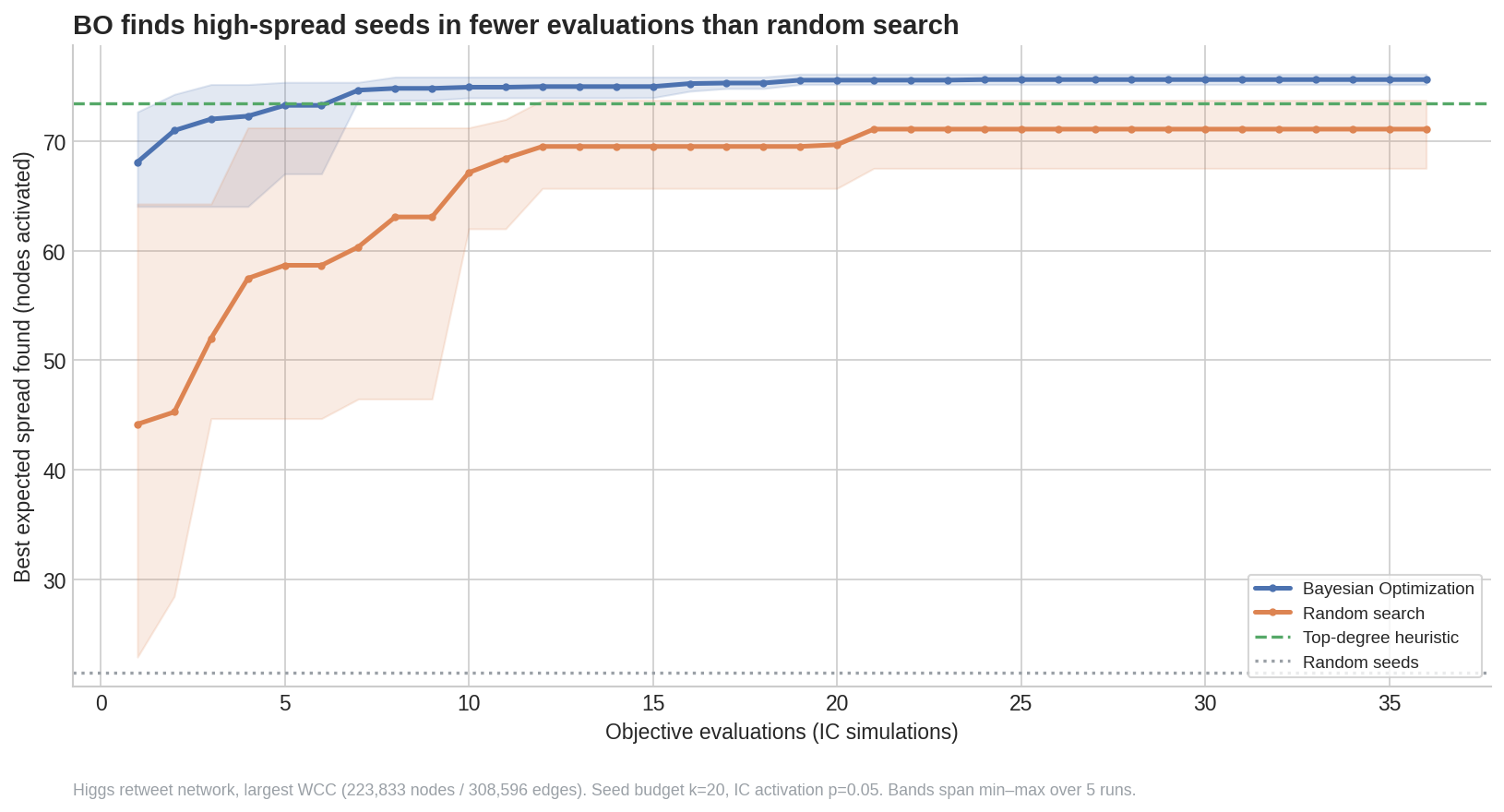 BO reaches high-spread seeds in far fewer objective evaluations than random search. Bands span min-max over five runs on the real Higgs retweet graph.
BO worked - in the narrow sense. It converged fast (well inside ten evaluations, versus twenty-plus for random search) and landed at a spread of 73.5, edging past top-degree’s 73.4. Against random seeds (21.5), PageRank (22.3), and k-core (23.1), everything degree-flavoured wins in a landslide.
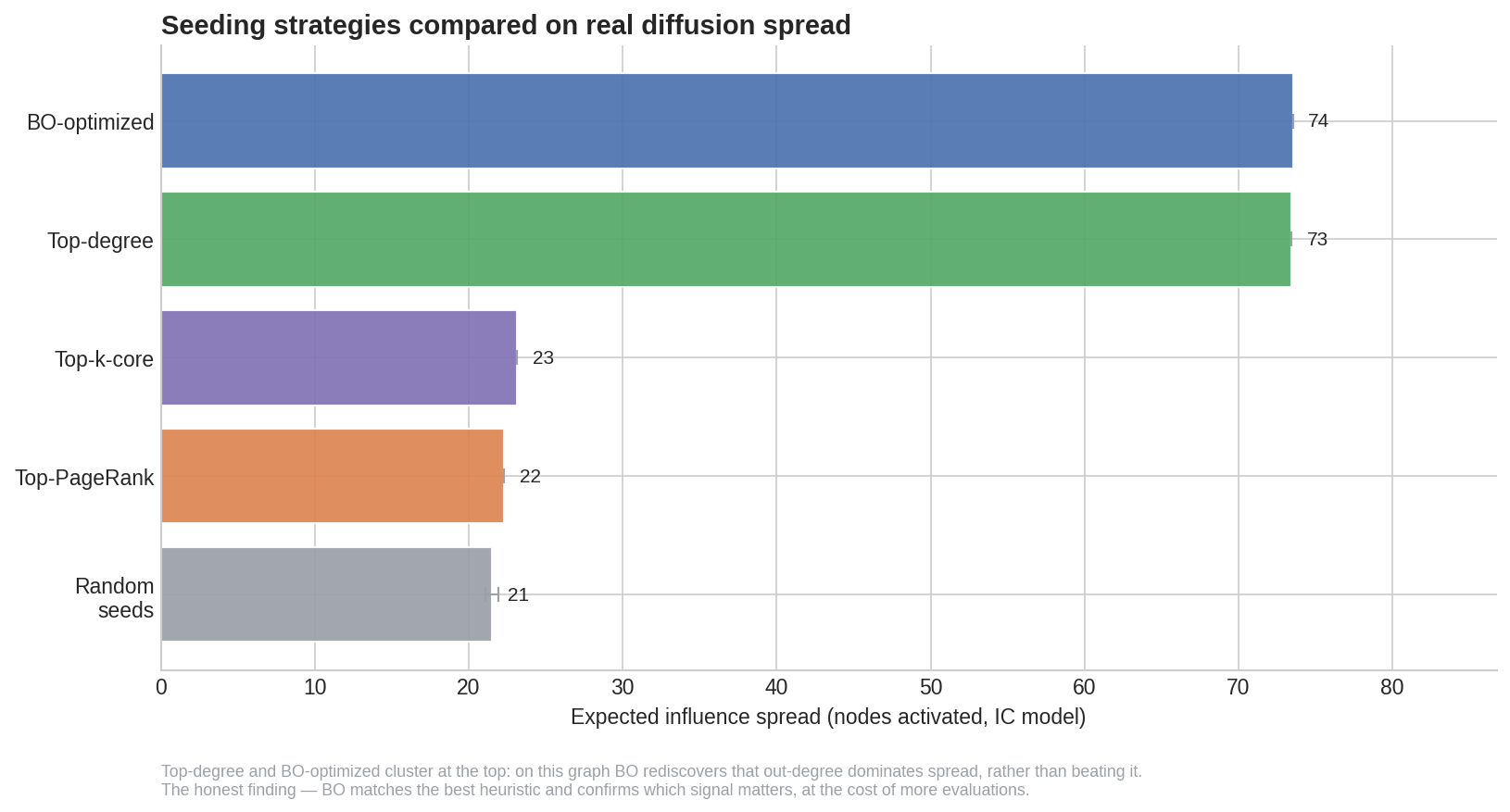 On this graph, out-degree dominates. BO rediscovers that fact rather than beating it.
But look at what BO actually learned: it put most of its weight on out-degree, a smaller share on k-core, and essentially zero on PageRank. It didn’t beat the heuristic - it rediscovered it. The optimizer had been handed a search space whose only good region was “basically top-degree,” and it dutifully found it. That’s a real result about the graph (out-degree carries the diffusion signal here), but it’s not a win for BO. It’s BO confirming the baseline.
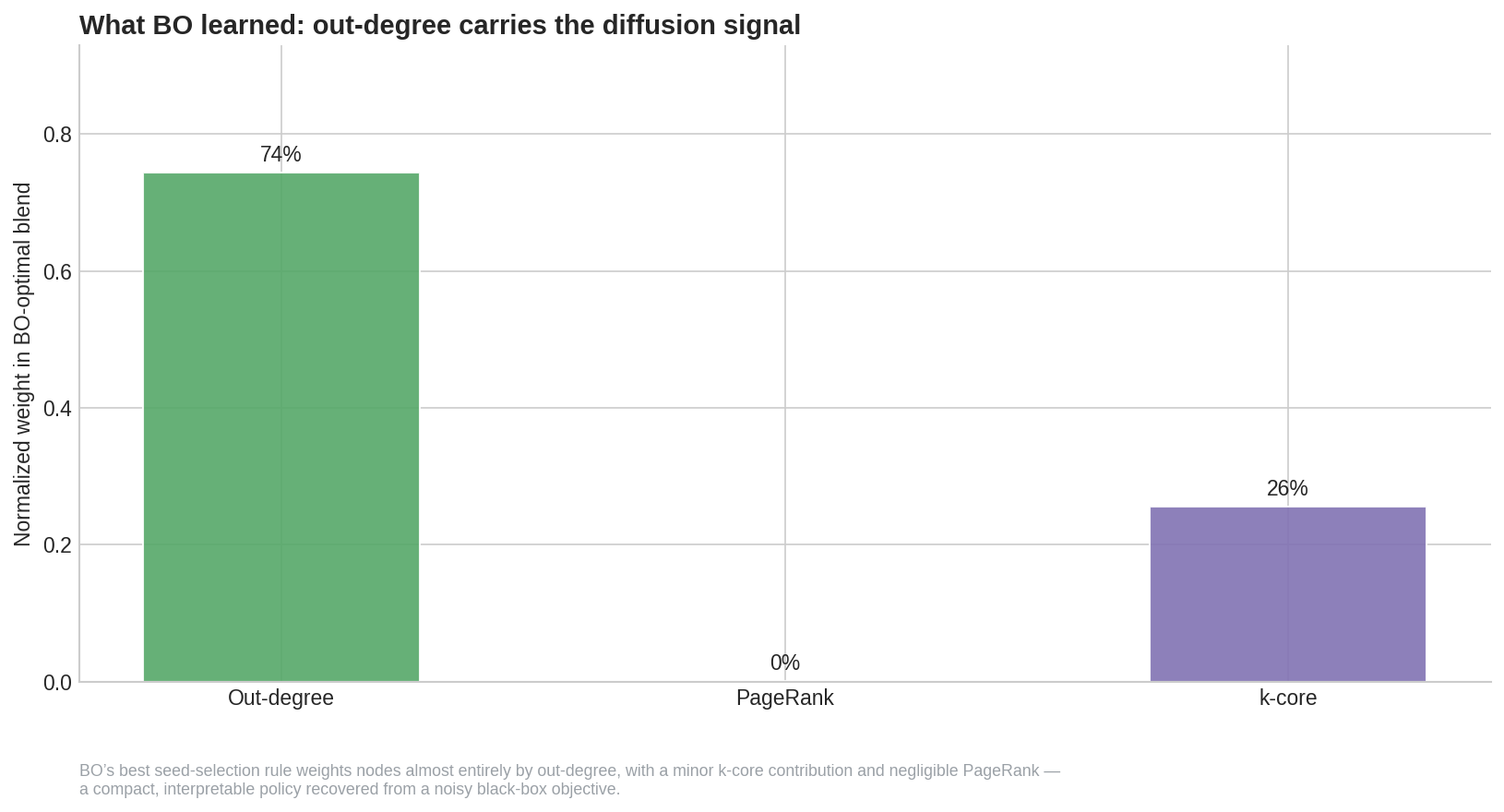 The learned ranking rule is interpretable: out-degree carries the diffusion signal, with PageRank effectively ignored.
Attempt 2 - Give BO room to be different
If reweighting rankings just recovers top-degree, the problem is that the design space can’t express anything top-degree can’t. So I widened it. Two changes: raise the cascade probability to p = 0.12 (bigger cascades, so seed overlap starts to matter), and add a redundancy penalty - a knob that discounts a candidate node if it sits near nodes already chosen. Now BO can, in principle, spread its seeds out to cover different regions of the graph, which is something a pure ranking cannot do.
This time BO reached 178.2 against top-degree’s 174.9, and beat CELF (149.6) comfortably. I ran a proper significance test - 30 high-precision estimates per seed set - and the gap held: +2.5%, p < 0.0001. A real, statistically significant win.
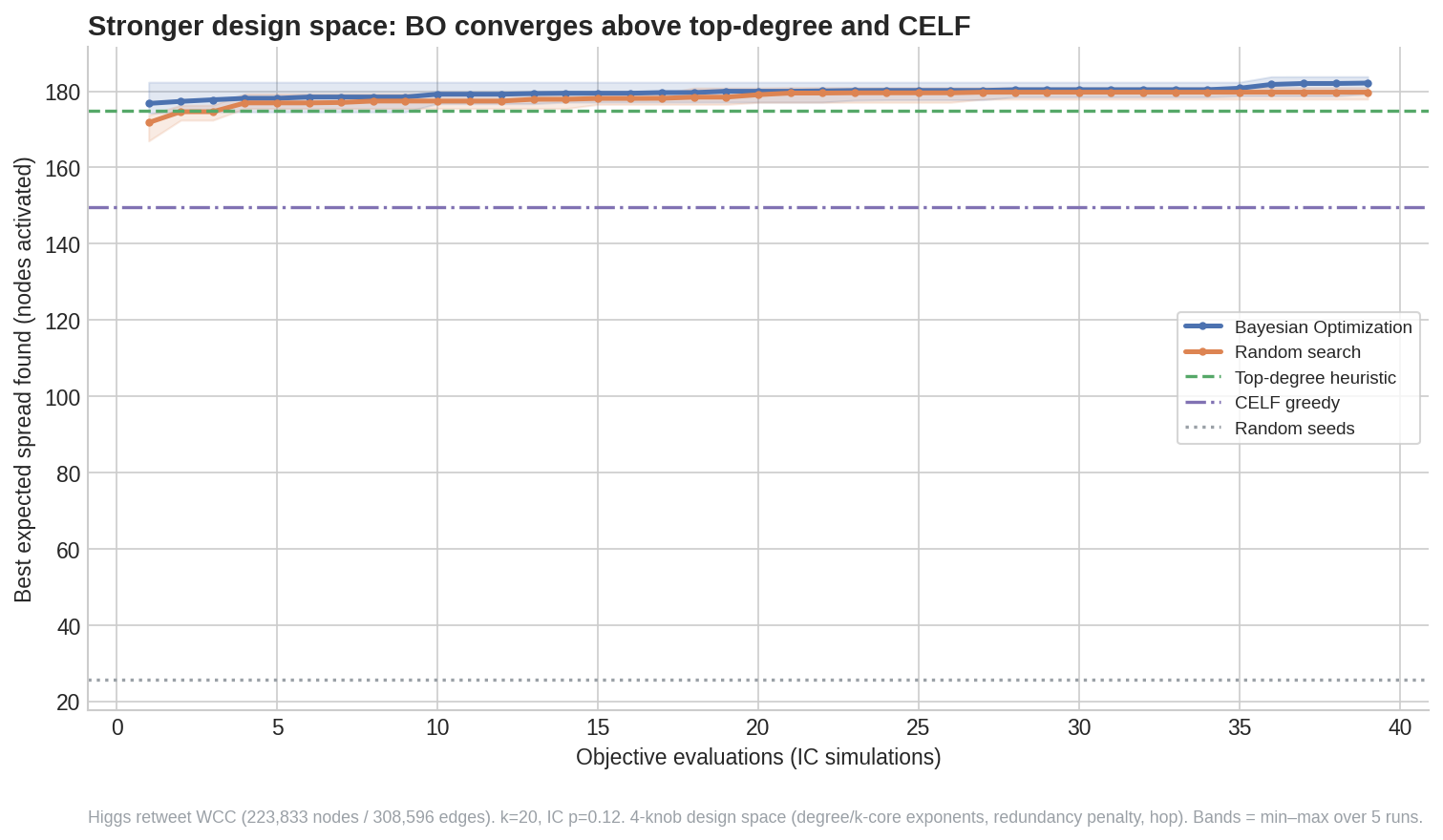 The stronger design space moves BO above top-degree and CELF, but the margin is still modest.
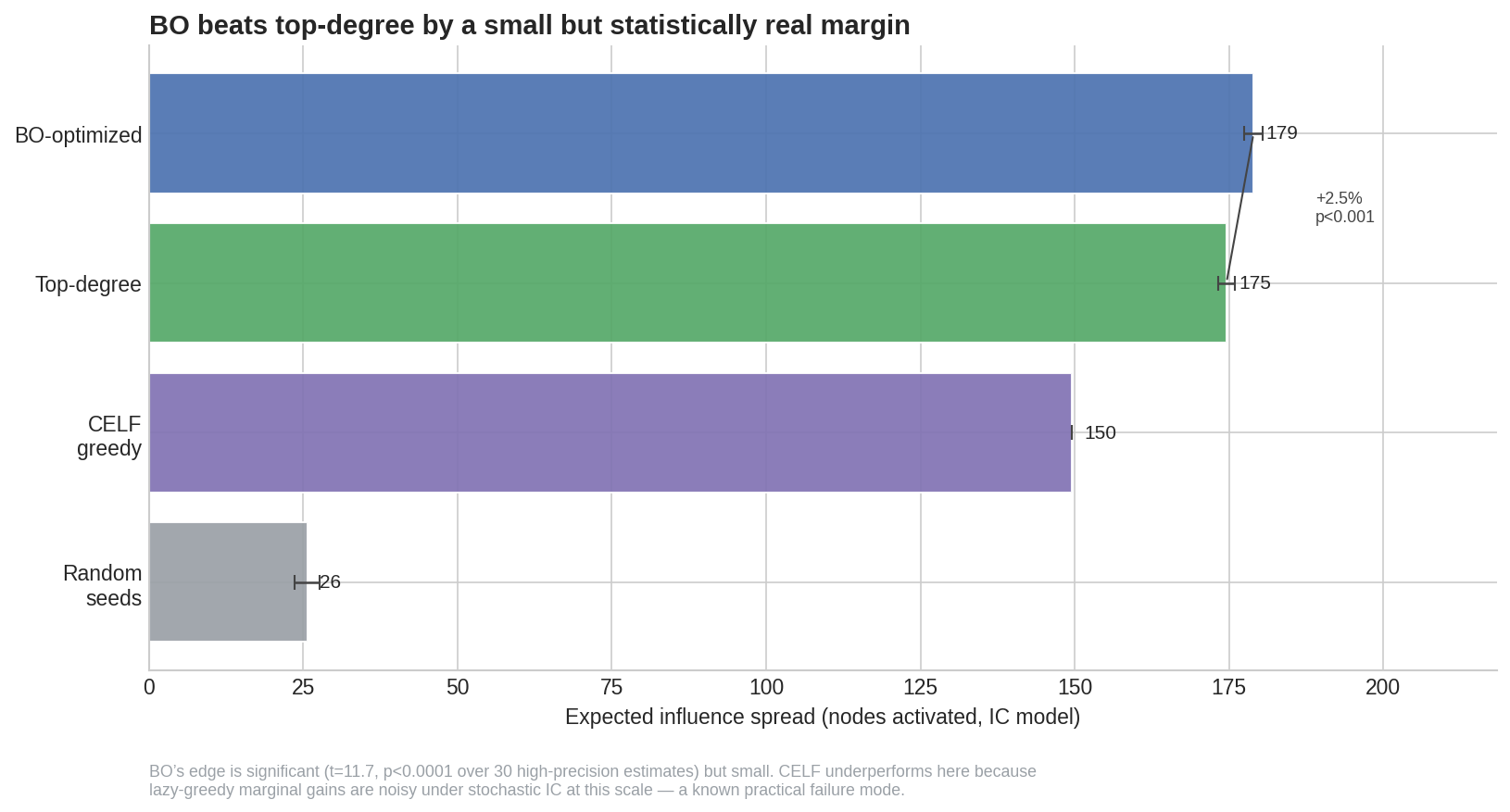 The gain is statistically real, but small: refinement, not a wholesale replacement for the heuristic.
Except the mechanism wasn’t what I’d designed for. BO’s winning seed set shared 18 of 20 nodes with top-degree, and the seed-region overlap was essentially identical (0.19 vs 0.20). The redundancy penalty barely fired. BO won by swapping out two weak hubs for two better-placed ones - fine-tuning, not diversity. The honest headline for attempt 2 is: a small, real refinement of top-degree, achieved by sharpening the degree signal rather than by the mechanism I added.
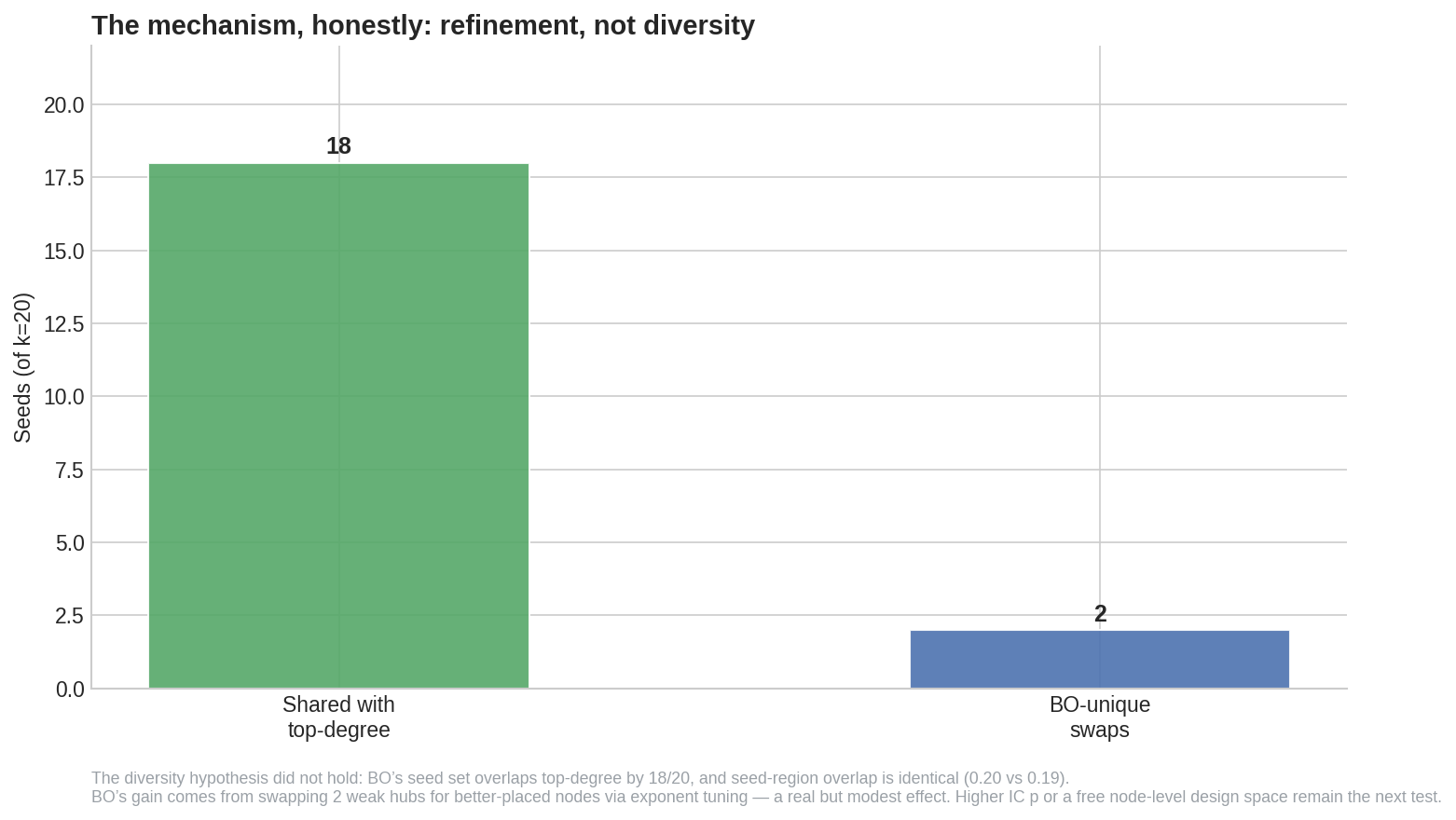 The mechanism is honest: BO mostly keeps the top-degree seed set and improves it through two better swaps.
Attempt 3 - Take the training wheels off
Fine. If I keep constraining BO to degree-adjacent rules, I’ll keep getting degree-adjacent answers. So attempt 3 removed the crutch entirely: let BO pick actual nodes, with no centrality ranking involved at all.
The trick for making that tractable: embed the candidate nodes into a 6-dimensional space using spectral embedding of the graph (nodes close together have correlated influence regions), then let BO place twenty “anchor points” in that space, each decoding to its nearest node. A 120-dimensional continuous search that can, in principle, land anywhere - including genuinely diverse, non-obvious seed sets no ranking would ever produce.
It was a decisive failure.
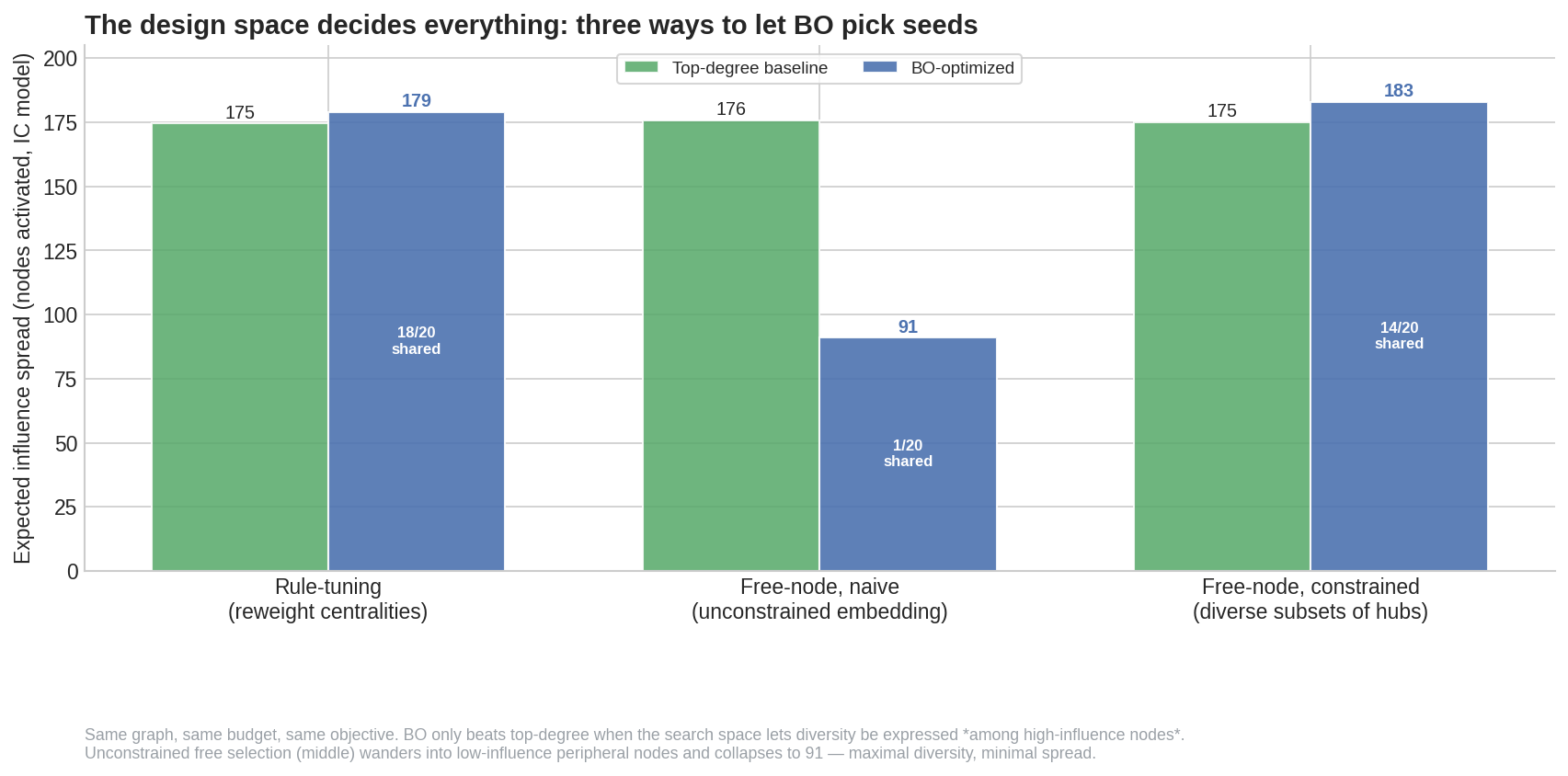 Same graph, same budget, same objective: three ways of framing the search space, three completely different outcomes.
Free-node BO collapsed to 91.0 against top-degree’s 175.8 - a 48% loss, p < 0.0001 in the wrong direction. And here’s the twist: it achieved exactly the diversity I’d been chasing. Its seed set shared just 1 of 20 nodes with top-degree; its influence-region overlap was the lowest of any run (0.11 vs 0.20). Maximal diversity, minimal spread.
Two things broke it. A 120-dimensional space is far too large for the ~50 noisy evaluations BO had to work with - it never escaped the region it started in. And the embedding, left unconstrained, decoded to low-influence peripheral nodes: BO spread its seeds beautifully across parts of the graph that don’t actually propagate anything. Diversity for its own sake is worthless if it means seeding dead ends.
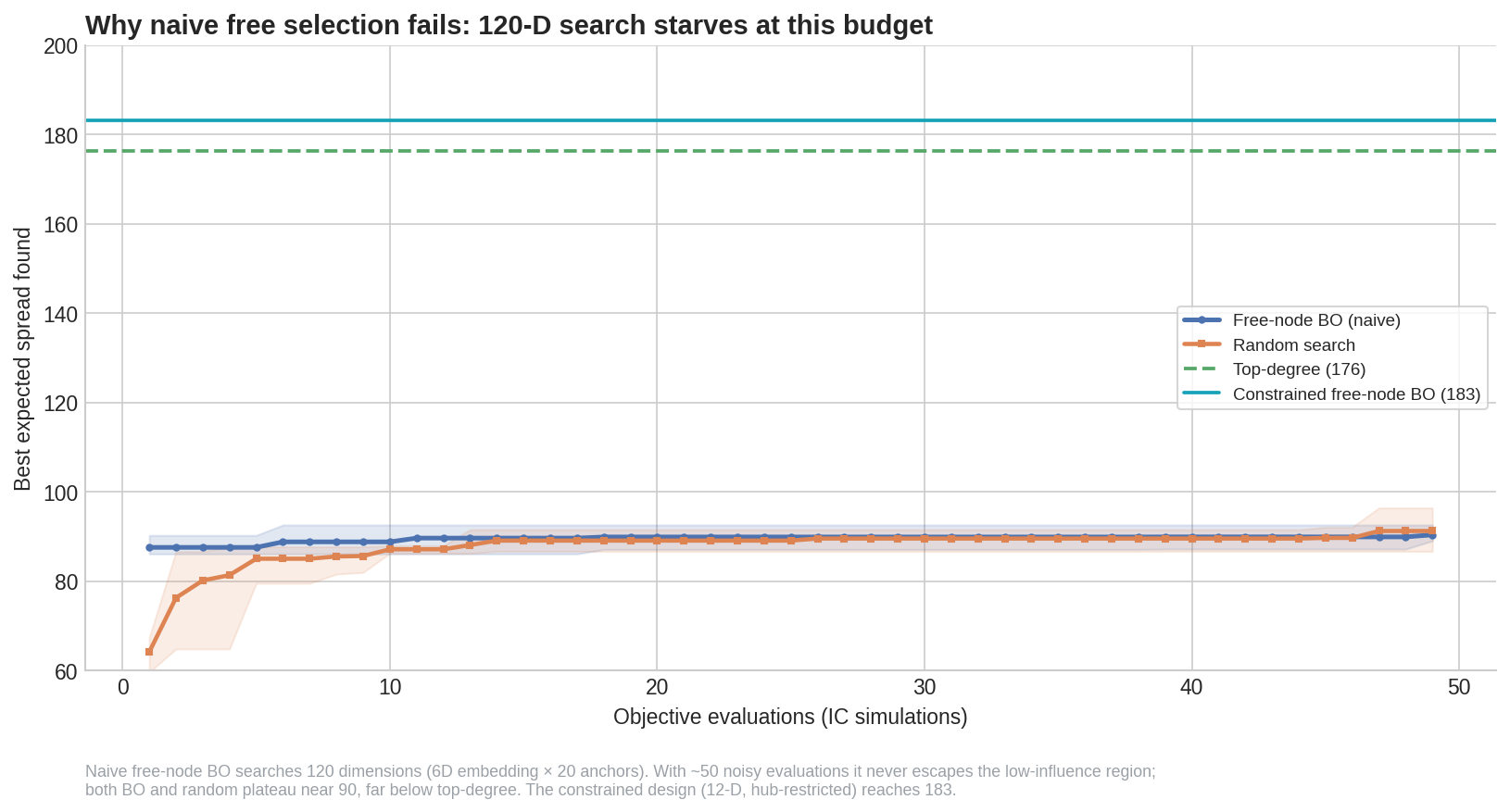 A 120-D search starves at this evaluation budget: both BO and random search stall near 90, nowhere near the baselines.
Attempt 4 - Diversity, but only among nodes that matter
The failure diagnosed the fix. Diversity isn’t the problem; unanchored diversity is. So attempt 4 constrained the free-node search to a pool of the strongest candidate nodes and let BO search for the best diverse subset among them - a compact 12-dimensional space, a redundancy penalty it could tune, and seeds guaranteed to be high-influence to begin with.
This was the best result of the four: 183.1 against top-degree’s 175.2
- +4.5%, p < 0.0001 - and this time it earned it honestly. BO’s seed set shared only 14 of 20 nodes with top-degree, meaning it replaced 30% of the naive hub picks with better-coordinated ones and came out ahead.
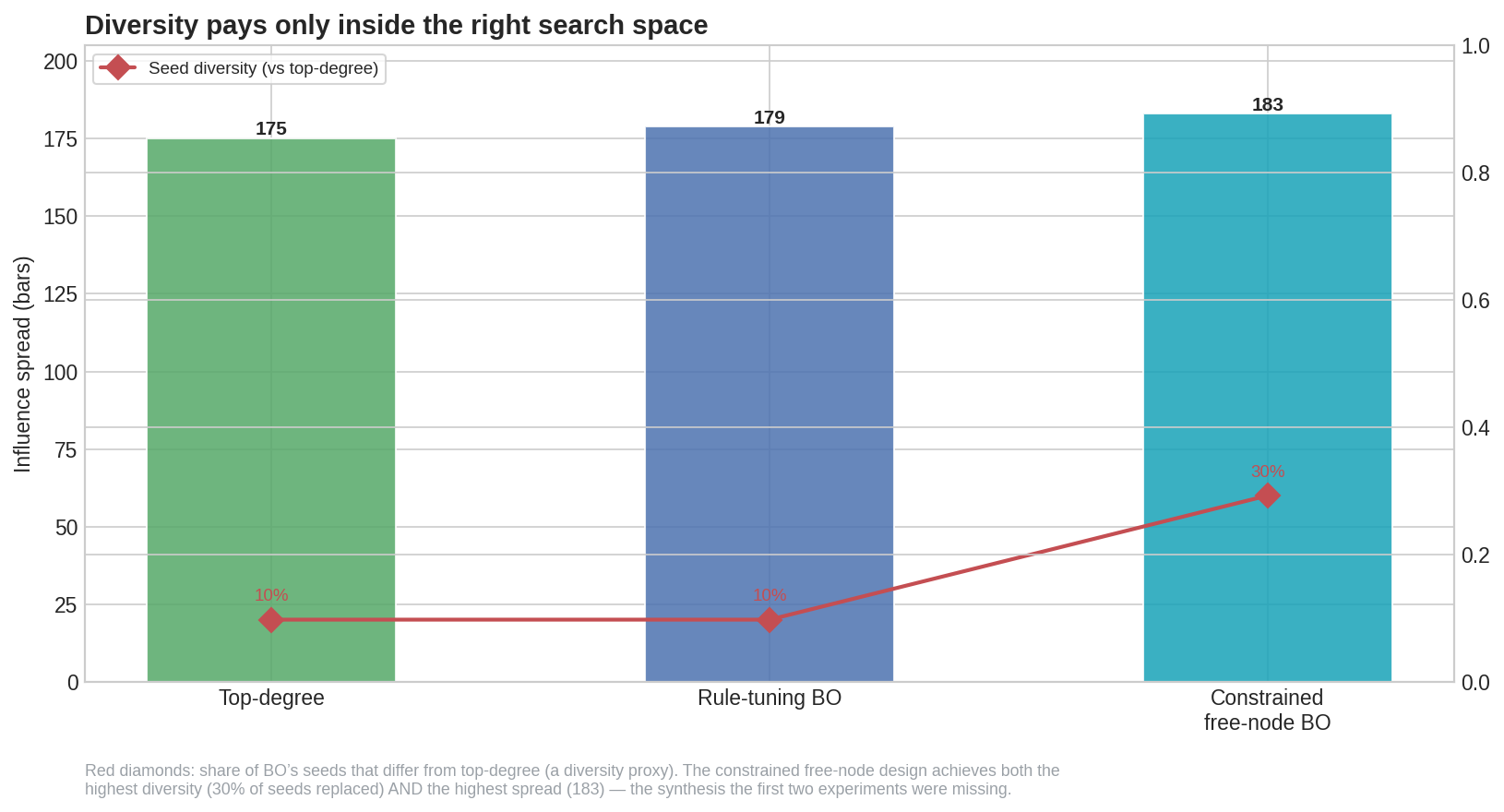 The synthesis: the constrained free-node design achieves both the highest diversity and the highest spread, which is the combination the first three attempts each missed.
Diversity finally paid - because it was diversity among nodes that can carry a cascade, not diversity in the abstract.
The actual finding
Line the four attempts up and the pattern is unmissable. Same graph. Same evaluation budget. Same objective function. Same optimizer. The only thing that changed was the search space, and the outcomes ran from a decisive loss to a decisive win:
| Attempt | Search space | Result vs. top-degree | Seeds shared |
|---|---|---|---|
| 1. Rule-tuning | reweight centralities | +0.1% (ties) | 18 / 20 |
| 2. Stronger rule | + redundancy penalty | +2.5% (refinement) | 18 / 20 |
| 3. Free-node, naive | 120-D embedding | −48% | 1 / 20 |
| 4. Free-node, constrained | diverse subset of hubs | +4.5% | 14 / 20 |
The lesson I actually take from this is not “Bayesian Optimization beats top-degree for influence maximization.” Sometimes it ties it, once it lost badly to it, and its best win was a few percent. The lesson is that the design of the search space determined everything, and the optimizer determined almost nothing. A well-posed space let a generic optimizer find a genuinely better, more diverse answer. A badly-posed space - even one with strictly more freedom - sent the same optimizer off a cliff. The freedom to pick any node (attempt 3) produced a worse result than the freedom to pick any weighting (attempt 1), because freedom without structure is just a bigger haystack.
That’s a boring-sounding conclusion and I think it’s the correct one. Most of the leverage in applying optimization to a real problem is upstream of the optimizer - in how you parameterize the thing you’re choosing.
Honest limitations
A few things I’d want a reader to hold onto before generalizing any of this:
The absolute margins are small. A few percent on one graph at one cascade probability is not a law of nature; it’s a result. The structural finding about search-space design is what I think travels, not the specific numbers.
The naive free-node failure (attempt 3) is partly a budget artifact. With more objective evaluations, or a smarter embedding, an unconstrained search might recover some ground. I didn’t test that, and I’d be careful claiming free-node search is inherently doomed - only that at a realistic budget it starved.
Everything is specific to this graph and p. Higher cascade probabilities change how much seed overlap costs you, which is precisely the regime where diversity should matter more. A natural next experiment is to sweep p and watch whether the diversity payoff in attempt 4 grows.
And CELF underperforming here (149.6, well below top-degree) is itself a known practical wrinkle: lazy-greedy marginal gains get noisy under stochastic IC at this scale. It’s a fair baseline, not a strawman, but its weakness on this graph is a property of the estimator, not evidence that greedy influence maximization is bad in general.
Code, data provenance, and reproduction steps:
github.com/ChinmayA301/blog-artifacts.
The figures above are generated by the scripts in virality-bayesian-optimization/charts/; the experiments that produce their inputs are in pipeline/, numbered in run order.
Sources
- SNAP Higgs Twitter dataset
- Kempe, Kleinberg, and Tardos, Maximizing the Spread of Influence through a Social Network
- Snoek, Larochelle, and Adams, Practical Bayesian Optimization of Machine Learning Algorithms
- BOPIM: Bayesian Optimization for Influence Maximization on Temporal Networks
- Experiment code and data provenance
After the last line
Comments & sharing
Agree, disagree, add context, or send this to someone who would have a take.
Share
Public thread
Comments are public and attached to this post through GitHub Discussions. Sign in with GitHub to join the thread.
Open public discussions