The Core Question
Bayesian Optimization (BO) is one of those ideas that feels almost magical:
You don’t know the function.
Evaluations are expensive.
So you build a probabilistic model and choose the next step intelligently.
Simple - until your search space stops being simple.
What happens when the thing you want to optimize is not a vector… but a subset of nodes in a graph?
Think:
- Choosing a group of influencers in a social network
- Selecting molecular substructures in drug discovery
- Picking strategic nodes in infrastructure systems
Suddenly, the space explodes.
For a graph with N nodes, choosing subsets of size k means:
Combinations = N choose k
This grows fast - terrifyingly fast.
Traditional BO breaks here.
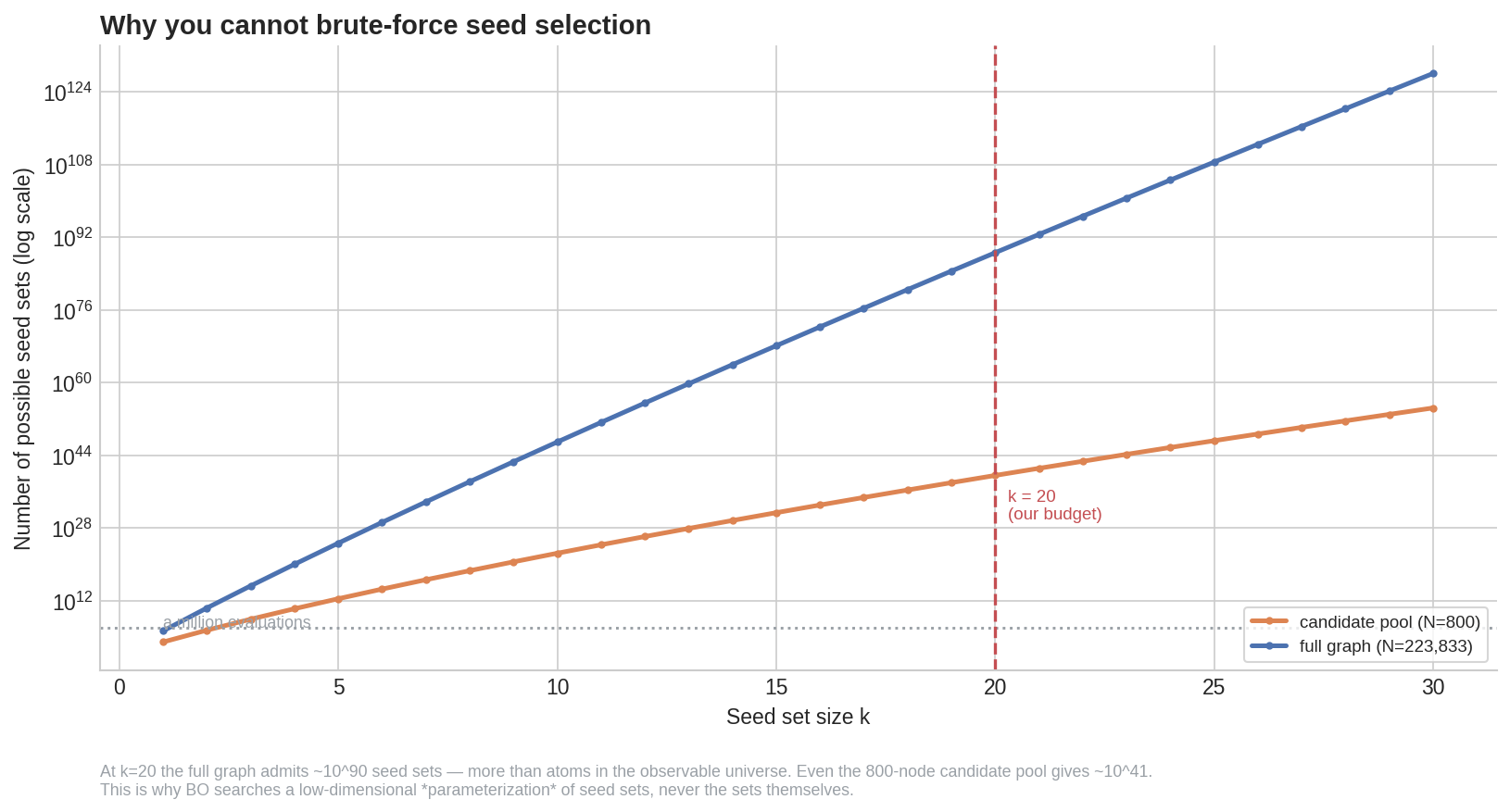 For the Higgs retweet graph, choosing 20 seeds from 223,833 nodes creates roughly 10^88 possible seed sets. Even a restricted 800-node candidate pool is still far beyond brute force.
And this is where the paper GraphComBO introduces a new way of thinking.
The Big Idea
Instead of forcing Bayesian Optimization to work in a space it wasn’t designed for…
Turn the search space itself into a graph.
That’s it. That’s the breakthrough.
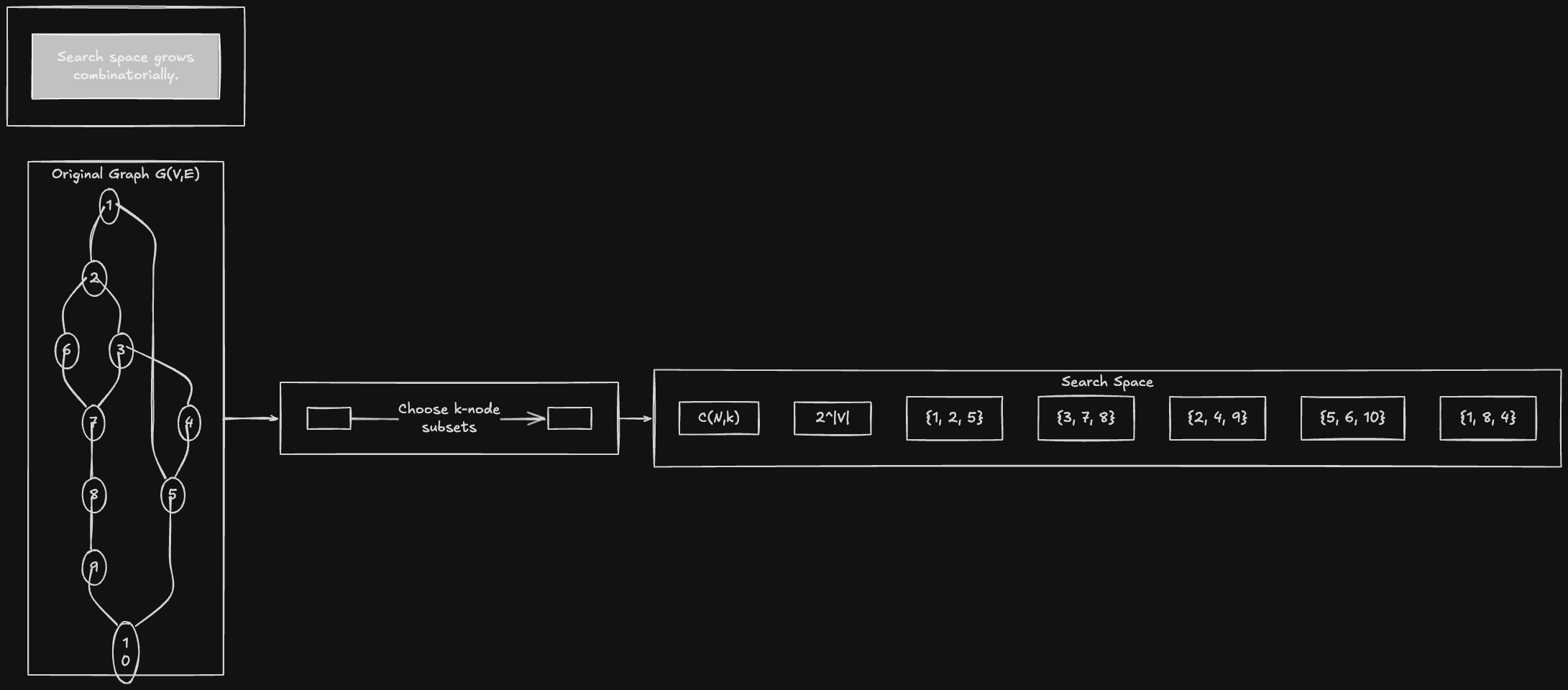
Enter the Combo-Graph
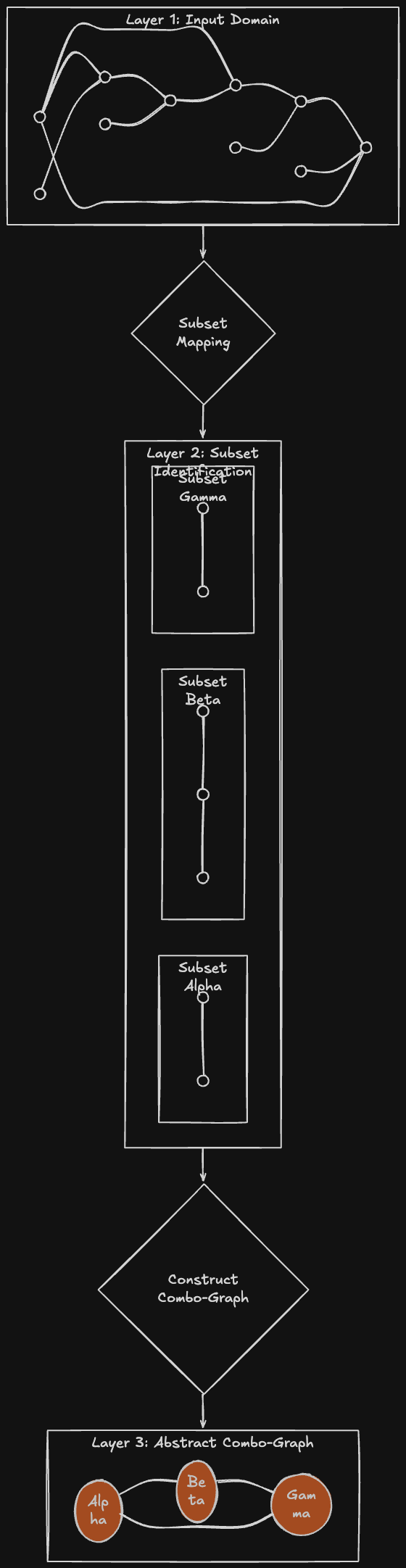
Imagine every possible subset of nodes as a point.
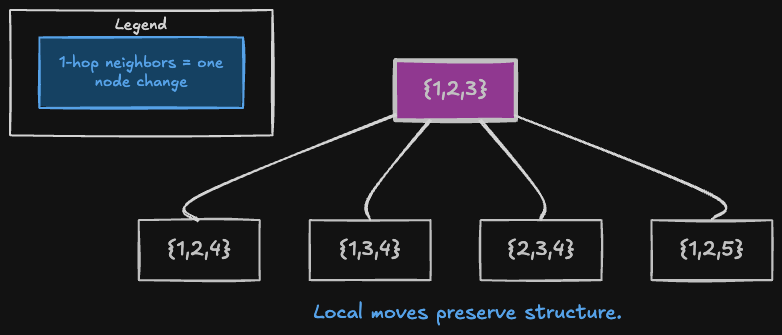
Now connect two subsets if:
- they differ by one node, and
- that node swap respects adjacency in the original graph.
You’ve just created a combinatorial graph.
Why this matters:
Instead of searching randomly through subsets, you can now:
➡️ walk through the space.
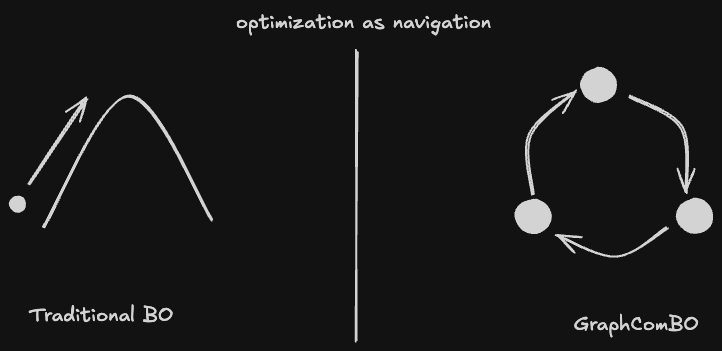
Optimization becomes navigation.
But There’s a Problem
The combo-graph is huge.
Massive.
Unbuildable.
So the authors borrow an idea from trust-region optimization:
Don’t model everything.
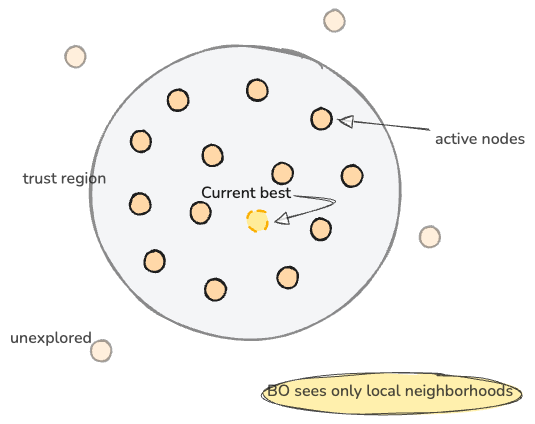
Model locally.
Local Exploration Instead of Global Modeling
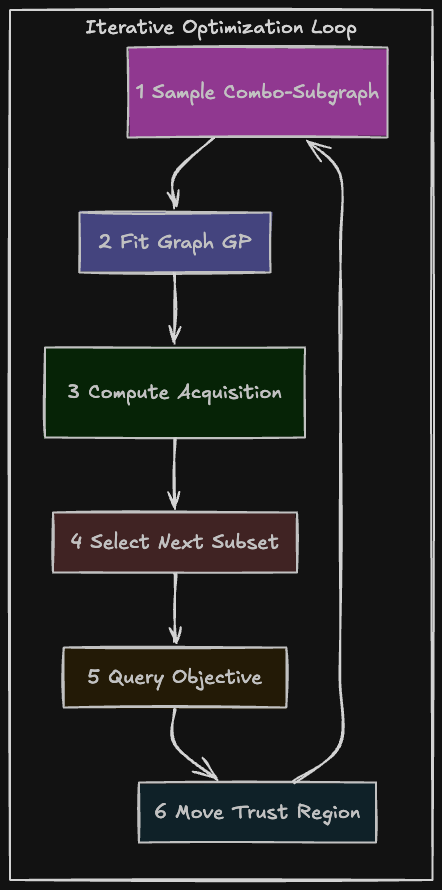
The algorithm:
- Pick a current subset (center).
- Build a small local neighborhood around it.
- Run Bayesian Optimization only inside this local region.
- Move the center if improvement happens.
It’s like exploring a dark cave with a flashlight.
You only see what’s near you - but you keep moving toward promising areas.
Gaussian Processes - But Graph-Aware
In classic BO, Gaussian Processes measure similarity in Euclidean space.
Here?
Similarity comes from graph structure.
The surrogate model uses:
- Graph Laplacians
- Eigenvectors
- Spectral kernels
Meaning:
Two subsets are similar if their positions in the combo-graph are structurally close.
The GP becomes a map of uncertainty over the graph itself.
Acquisition as Movement
Expected Improvement (EI) now answers:
Which neighboring subset should I visit next?
The algorithm:
- evaluates EI locally
- moves to the best neighbor
- updates the model
- repeats.
Optimization becomes intelligent exploration.
The Deeper Insight
This paper quietly shifts the way we think about BO.
Traditional view:
BO optimizes over vectors.
New view:
BO navigates structured spaces.
This is bigger than graphs.
It suggests BO could work naturally on:
- symbolic structures
- program trees
- combinatorial systems
- multi-agent configurations
What Happens in Practice?
In a small experiment (Karate Club network):
- BO quickly finds high-influence subsets.
- Local search works surprisingly well.
- But uncertainty estimates degrade far from known regions.
Exactly what the theory predicts.
A Real-Graph Artifact: Where the Seeds Land
The same idea shows up in the Higgs retweet graph experiment. The question is not only whether BO finds high-spread seeds, but where those seeds sit in the graph.
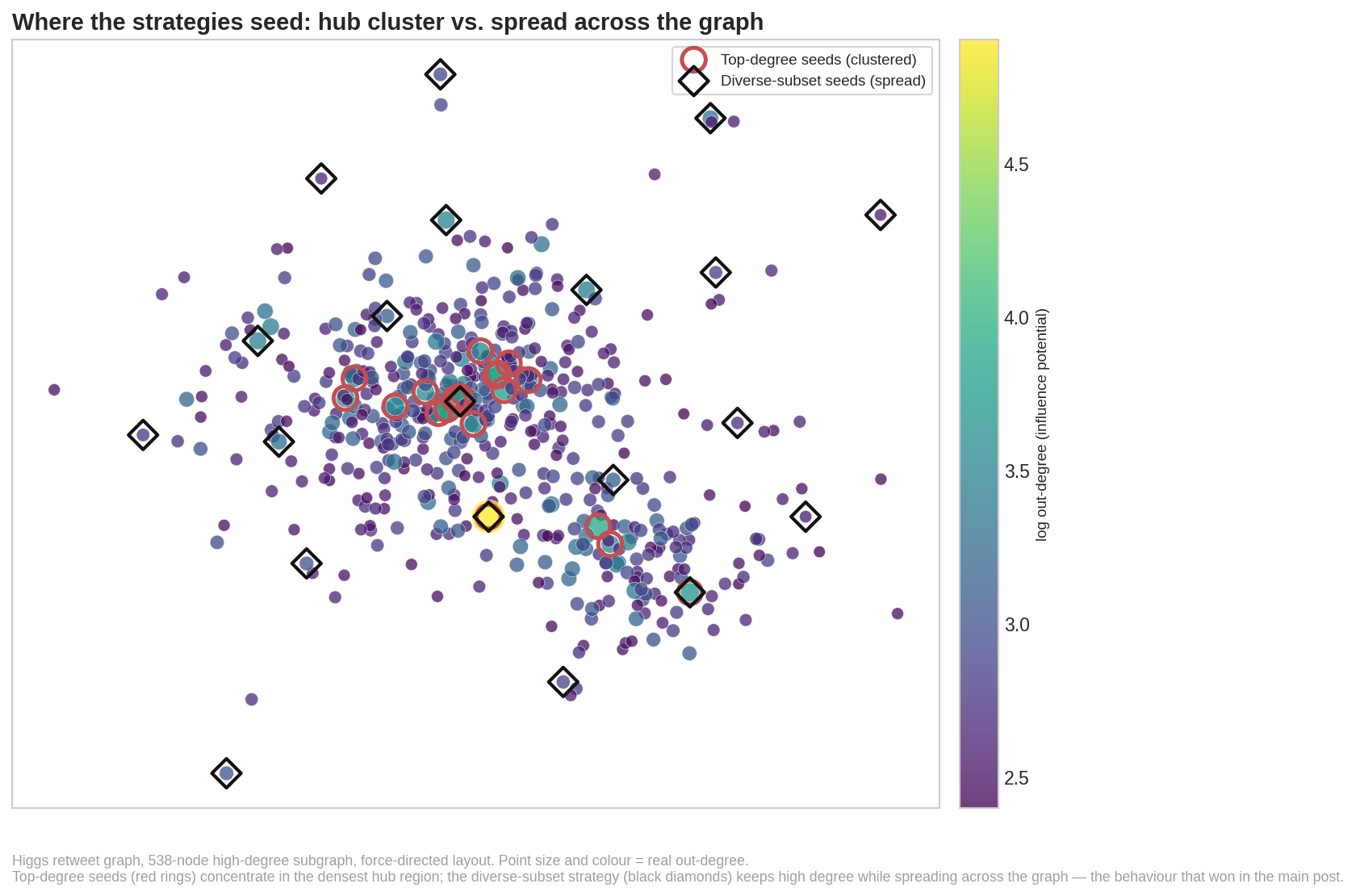 Real data artifact: 538-node high-degree subgraph from the Higgs retweet network. Top-degree seeds cluster in the densest hub region; the diverse-subset strategy keeps high out-degree while spreading across the graph.
This is the practical version of the GraphComBO idea: do not brute-force the graph. Build a structured search space where the optimizer can move among meaningful graph configurations.
Where the Cracks Appear
No idea is perfect.
Key limitations:
- Embeddings may be too shallow → GNNs could help.
- Greedy acquisition search misses global moves.
- GP scaling becomes painful on large graphs.
- Assumes static, fully known graphs.
Interestingly, the authors acknowledge many of these - especially how performance drops as subset size grows.
Why This Feels Like a Beginning
GraphComBO doesn’t feel like a finished solution.
It feels like a new lens.
A new way to frame optimization:
Not as solving a function, but as moving intelligently through a structured universe.
Future Directions (Where This Could Go)
- GNN-powered surrogate models
- RL-based acquisition optimization
- Adaptive trust-region sizes
- Dynamic graphs that evolve over time
- Hybrid local-global exploration strategies
This is where sequential decision-making and BO start to merge.
Final Thought
Most optimization research tries to simplify complex spaces.
This work does something different.
It accepts complexity, and teaches the algorithm how to move inside it.
And maybe that’s the real idea worth remembering:
Sometimes optimization isn’t about finding the answer.
It’s about learning how to walk through the space.
References
- Liang, H. (2024). Bayesian Optimization of Functions over Node Subsets in Graphs
- Snoek et al. (2012). Practical Bayesian Optimization
- COMBO, BOCS, BayesOptG
Author Note
Written as part of my exploration in AI for Sequential Decision Making
MS Data Science - University of Minnesota
After the last line
Comments & sharing
Agree, disagree, add context, or send this to someone who would have a take.
Share
Public thread
Comments are public and attached to this post through GitHub Discussions. Sign in with GitHub to join the thread.
Open public discussions