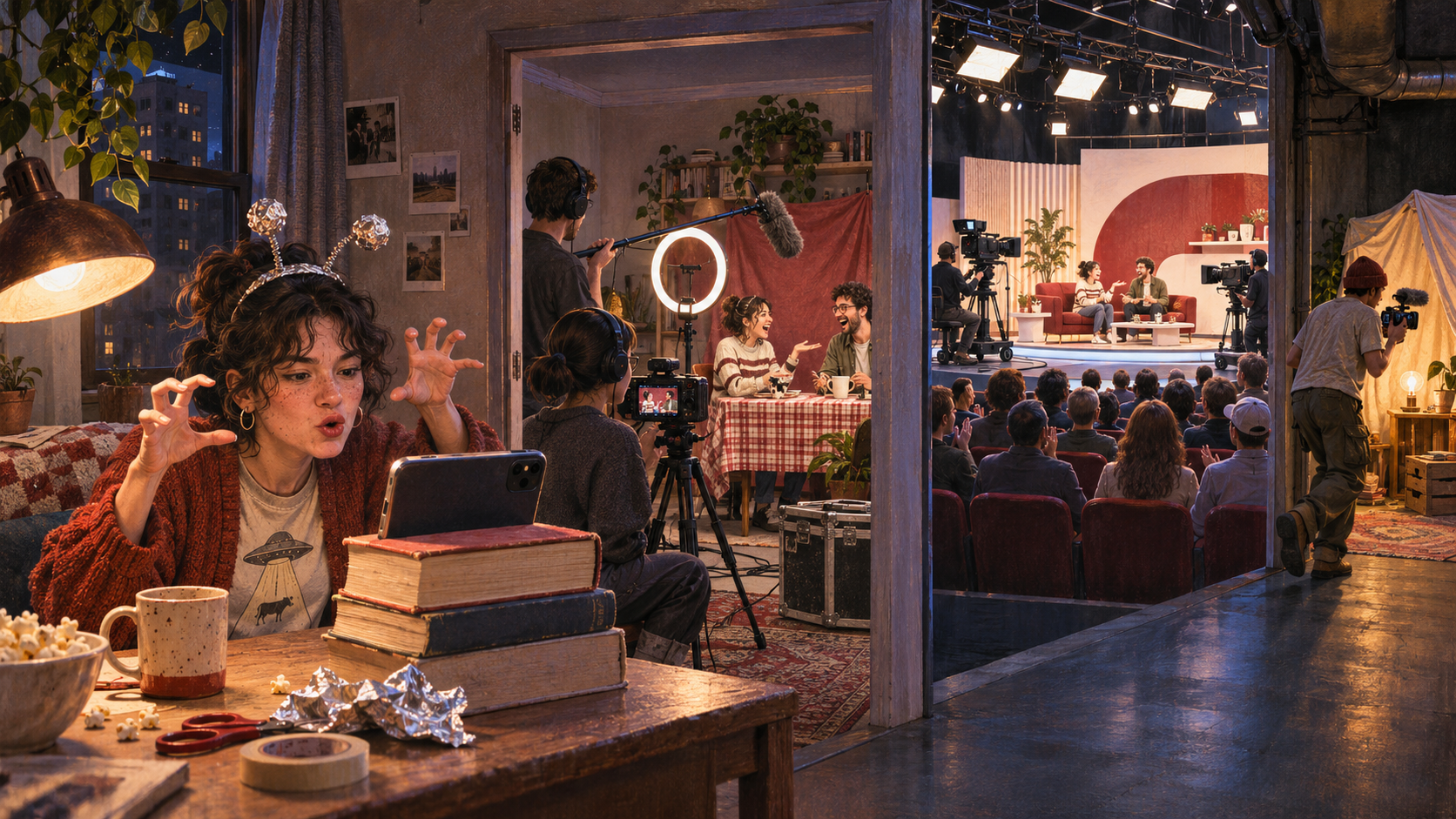
A loose experiment acquires a crew, a set, and a repeatable format. At the edge of the studio, somebody starts making the next strange thing. Illustration generated for this essay.
The television in my hand
I am standing in a kitchen with the exhaust fan rattling above me, watching three people perform a sketch on a screen smaller than my palm.
The cuts arrive every second. There are captions the size of street signs. One person plays four characters. The joke ends before the pan warms, and the next video begins with a man interviewing strangers under studio lights.
None of this looks like the television set I grew up with. It has no remote, no fixed schedule, no family negotiation over the channel.
It feels like television anyway.
For years, the internet’s favorite story about itself was that it had killed TV. It replaced gatekeepers with creators, schedules with feeds, studios with bedrooms, and polished scripts with a person speaking directly into a webcam.
Then the bedrooms acquired lighting rigs. The creators hired researchers, editors, producers, lawyers, and thumbnail designers. The spontaneous upload became a weekly franchise. Dating shows returned wearing platform-native clothes. Game shows came back with comment sections.
Maybe the internet did not kill television. Maybe it disassembled television, handed the pieces to everybody, and waited for us to rebuild it.
The progression is visible, but it is not a circle
Early YouTube in India smelled of borrowed rooms and improvised props. AIB, TVF, The Timeliners, and dozens of smaller channels made sketches that felt closer to college theatre than broadcast entertainment. Their work could be carefully written and edited, but it retained the electricity of people discovering a form while using it.
Short-form video now carries part of that energy. A creator needs a phone, a corner with decent light, and an idea that survives the first two seconds. Characters reappear. Catchphrases spread. A visual grammar develops in public.
Meanwhile, the largest YouTube productions increasingly resemble television. They have sets, recurring segments, casting, sponsor integration, production calendars, and budgets large enough to make failure expensive. Livestreaming, once defined by the raw fact of being present with somebody, now produces arena events, competitions, talent formats, and multi-camera spectacles.
It is tempting to draw a wheel:
television → YouTube → short video → livestreaming → television again
But that is too neat. Old forms do not vanish when the new one arrives. A teenager livestreaming a game from a bedroom and a streamer filling a stadium are both using the same medium. A deliberately rough video can be written by a professional team. A six-camera show can still contain a live audience interaction that television could never reproduce.
The pattern is better understood as a lifecycle.
Novelty, creators, audience, money, studios
An entertainment medium often begins with a technical permission.
You can upload without a broadcaster. You can go live without a satellite truck. You can publish vertically from a phone. You can speak to ten thousand people without renting a theatre.
Then creators discover what the permission is good for. They make awkward things. Some fail in ways no established studio would finance. Audiences develop habits around the winners. Money arrives because a predictable audience is valuable. Once enough money sits on the table, organizations form to make the result repeatable.
flowchart LR
    A["Novelty"] --> B["Creators"]
    B --> C["Audience"]
    C --> D["Money"]
    D --> E["Studios"]
    E --> F["Repeatable formats"]
    F -. "experimentation escapes" .-> A
This is a proposed lifecycle, not a universal law. Its speed depends on the platform, the cost of production, advertiser demand, regulation, and whether the audience wants polish in the first place.
Still, the pressure is easy to recognize. Once a creator employs fifteen people, “let us try something strange” is no longer only an artistic decision. Salaries are due. Sponsors expect delivery. The upload calendar has empty boxes. An experiment that confuses half the audience may be exciting and financially reckless at the same time.
Studios do not appear because creators have lost their souls. They appear because success creates obligations.
Three things that should not be collapsed
Production quality, authenticity, and audience participation are not a single slider.
| Dimension | Low end | High end | What can change independently |
|---|---|---|---|
| Production | One camera, improvised room | Sets, crews, multiple cameras | Budget and technical polish |
| Authenticity | Heavily performed persona | Felt intimacy or candid presence | The audience’s belief in access |
| Participation | Watch and leave | Vote, chat, influence, remix | The audience’s power over the event |
A polished livestream can feel more intimate than a rough prerecorded sketch because the performer responds to the room. A supposedly candid vlog can be more engineered than a game show. Short-form creators can look spontaneous while following a rigid template learned through hundreds of iterations.
This distinction matters because “becoming television” does not simply mean buying better cameras. It means acquiring television’s organizational logic: schedules, formats, risk management, repeatability, recognizable talent, and a business that cannot depend on inspiration arriving Thursday morning.
The format becomes the boss
The first successful episode feels like an accident. The tenth needs a name. The fiftieth needs a production bible.
Audiences help harden the format. They subscribe for a particular sensation and become irritated when it changes. Platforms reward the familiar signals that previously held attention. Sponsors want to know what they are buying. Creators learn to reproduce the shape of their own success.
There is nothing inherently bad about this. Constraints can sharpen work. A recurring structure can support better jokes, deeper characters, and a shared language with the audience.
But every successful format produces a shadow: the ideas that do not fit inside it.
The creator known for interviews has a fictional short film in a folder. The comedy channel wants to attempt something quiet. The streamer wants to disappear for a month and build an experience that cannot be clipped into highlights. The organization built to protect creation begins protecting the format instead.
That is when the weird internet moves.
Where unseriousness goes
The experimental internet usually survives in spaces where the stakes are still low enough to be embarrassing.
It moves into private group chats, tiny Discord servers, game modifications, anonymous accounts, niche forums, collaborative documents, strange livestreams with forty viewers, and platforms adults have not yet learned to monetize cleanly.
The important feature is not a particular app. It is the temporary absence of expectation.
People can be unserious when nobody has built a dashboard around the behavior. They can make a form badly, abandon it, combine it with something else, and return three months later. The work does not need to support a company. It barely needs to explain itself.
Then someone notices. An audience gathers. The jokes acquire lore. A creator emerges. Money arrives carrying a microphone and a content calendar.
The escape begins again.
The next somewhere
If YouTube became television, and livestreaming is developing YouTube’s production machinery, where does the weird, experimental internet go next?
AI-generated entertainment is an obvious candidate, although “AI content” is too broad to name a form. The interesting experiments may be shows that respond to one viewer, stories that change when a group argues with them, characters that remember the audience, or games assembled around a joke and discarded that evening.
The audience may stop being an audience. It may become cast, editor, heckler, world-builder, or accidental training data. Some of that will be delightful. Some will be exploitative. Much of it will be awful in ways we have not seen before, which is often how a medium sounds before it learns its grammar.
The next experimental space could also be smaller, not more technical: media shared among twenty people, meaningful because every person understands the references. A culture optimized for scale may rediscover the pleasure of making something that cannot travel.
I do not know which form wins. I am more interested in the gap before winning becomes the objective.
Back in the kitchen, the sketch ends. The phone offers another, then another. Somewhere else, somebody has opened a camera and is making a thing that does not yet look professional enough to copy.
Maybe the internet doesn’t keep killing television. Maybe it keeps rebuilding television, then inventing somewhere else to escape it.
After the last line
Comments & sharing
Agree, disagree, add context, or send this to someone who would have a take.
Share
Public thread
Comments are public and attached to this post through GitHub Discussions. Sign in with GitHub to join the thread.
Open public discussions