Core idea:
Treat AI deployment as a public accountability system with repeatable controls, not a one-off technical experiment.
1) The Work Problem (Not the Model Problem)
When local governments talk about “using AI,” the first constraint isn’t model capability, it’s operational reality:
- Data access and purpose limitation
- Traceability (what influenced an outcome?)
- Defensibility (can we explain it under review?)
- Measurable impact (time, quality, equity - consistently)
- Safe iteration (pilot → learn → scale without chaos)
So the technical core becomes: build a system where AI outputs are governed, measured, and explainable by default.
2) A Reference Architecture: “Audit-First AI” for Service Delivery
Think of AI as a component in a broader pipeline, where the pipeline is the product.
2.1 System Components
Inputs
- Service requests (forms, 311, web chat, email)
- Knowledge base (policies, procedures, service catalogs)
- Contextual metadata (channel, timestamps, language needs)
AI components (examples)
- Classifier for routing / categorization
- Summarizer for agent assist
- Retrieval-augmented response drafting
- Document extraction (OCR → structured fields)
Human controls
- Review/override actions
- Escalation paths
- Exception handling
Auditing + governance
- Decision logs
- Model/version registry
- Monitoring dashboards (outcomes + drift)
- Recurring governance review cadence (monthly/quarterly)
3) Governance Workflow as a Technical Pipeline
A governance model should behave like an engineering workflow: clear states, required artifacts, and “gates.”
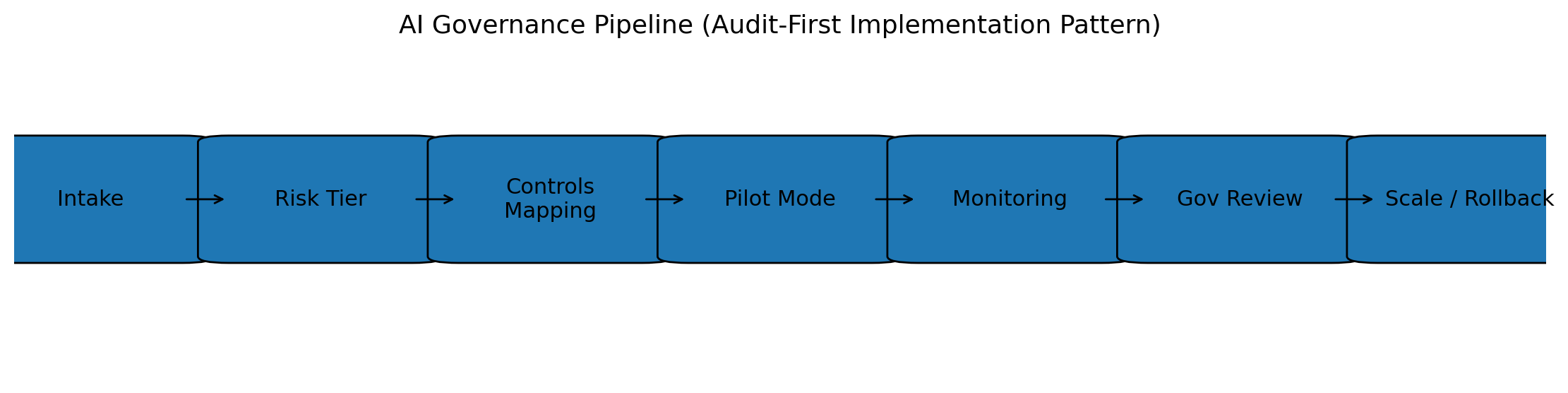
3.1 AI Use Case Intake → Risk Tier → Controls
Step A: Use-case intake (structured form) Required fields:
- What decision/outcome does AI influence?
- Who is affected (resident/staff/both)?
- What data is used (source + sensitivity)?
- What is the failure mode (worst-case)?
- What is the fallback (human process)?
Step B: Risk tiering A pragmatic tiering heuristic:
- Tier 0 (Assistive, non-decision): drafting, summarizing, search
- Tier 1 (Operational suggestion): routing suggestions, prioritization hints
- Tier 2 (Outcome influencing): eligibility recommendations, risk flags
- Tier 3 (Rights/safety critical): anything that can materially harm access, legal status, safety, or protected outcomes
Step C: Control mapping Controls scale by tier:
- Tier 0: logging + basic monitoring
- Tier 1: logging + override + periodic QA
- Tier 2: logging + override + bias review + threshold policies + rollback plan
- Tier 3: strict approvals, impact assessment, rigorous evaluation, continuous monitoring, independent review
 —
—
4) The Audit Log: Minimal Schema That Makes Everything Defensible
If you can’t reconstruct “what happened,” you can’t govern it.
4.1 Suggested Event Schema (Decision Trace)
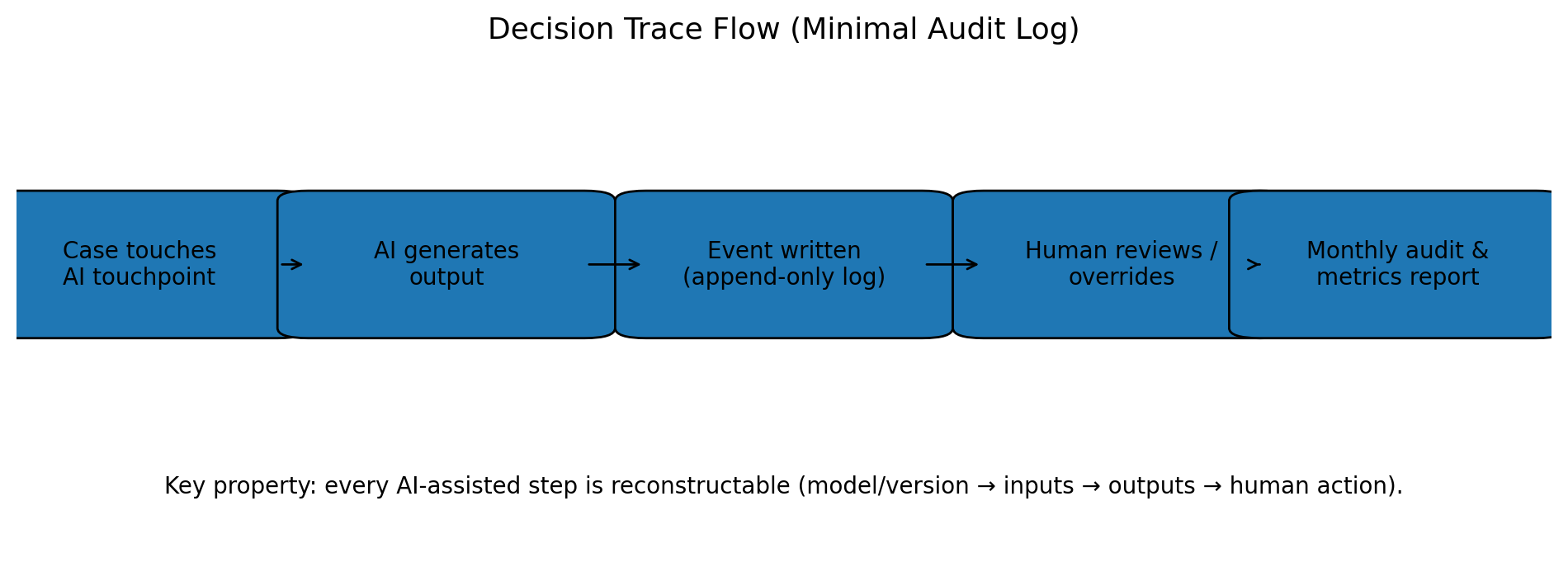
Store an append-only event log for every AI-assisted step:
{
  "event_id": "uuid",
  "timestamp": "2026-02-24T14:05:21Z",
  "case_id": "SR-123456",
  "touchpoint": "intake|triage|draft_response|eligibility|followup",
  "ai_system": {
    "name": "routing_classifier",
    "model_version": "v1.3.2",
    "prompt_or_config_hash": "sha256:...",
    "retrieval_corpus_version": "kb_2026_02"
  },
  "inputs": {
    "channel": "web_form",
    "text_hash": "sha256:...",
    "features_used": ["topic_terms","zipcode","language_pref"]
  },
  "outputs": {
    "recommendation": "Service=HousingSupport;Queue=Urgent",
    "confidence": 0.81,
    "alternatives": [{"label":"GeneralInquiry", "p":0.12}]
  },
  "human_action": {
    "reviewed": true,
    "overridden": false,
    "override_reason": null,
    "agent_id_hash": "sha256:..."
  },
  "policy_context": {
    "risk_tier": 2,
    "required_controls_met": ["override_enabled","qa_sampling"]
  }
}
This level of trace lets you answer:
- What model/version ran?
- What it recommended, with what confidence?
- What the human did
- Which controls applied
 —
—
5) Measurement: Turning “AI Value” into Quantifiable Outcomes
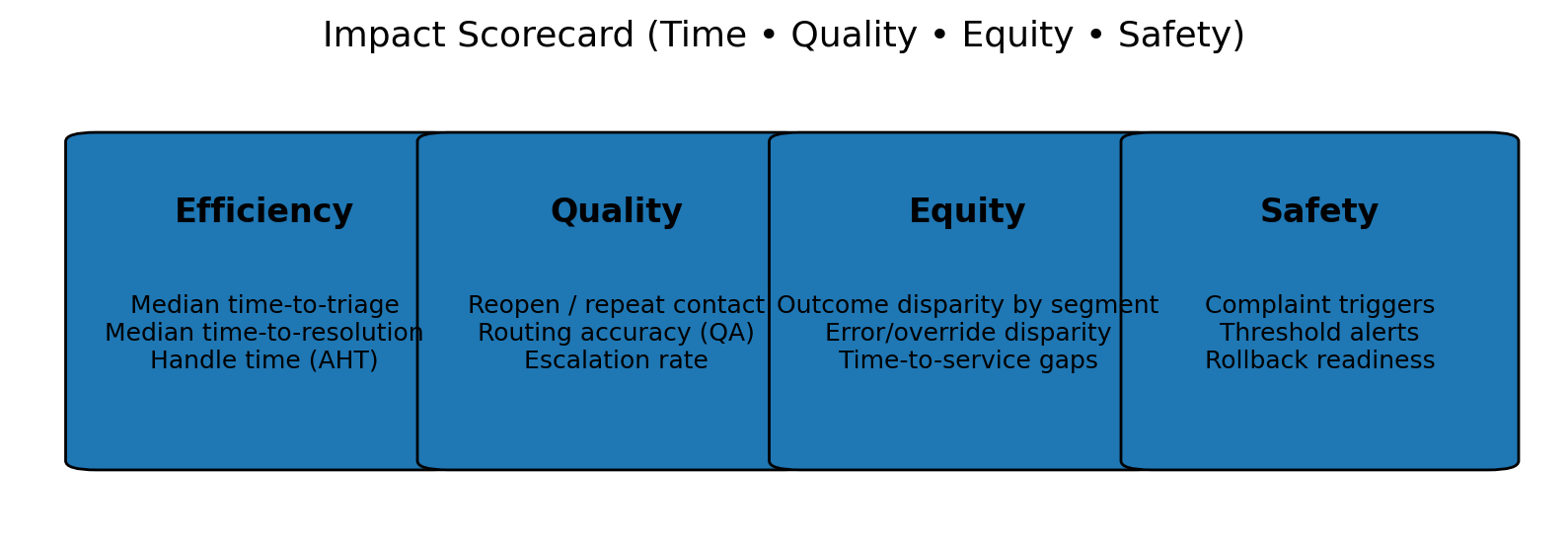
You need a metric suite that survives scrutiny. I use three primary pillars:
5.1 Efficiency (Time)
Examples:
- Median time-to-triage
- Median time-to-resolution
- Staff handle time (AHT) changes (if available)
Δ Efficiency (example): \(\Delta T = \mathrm{Median}(T_{\text{baseline}}) - \mathrm{Median}(T_{\text{AI}})\)
5.2 Quality (Correctness + Service Outcomes)
Examples:
- Reopen rate / repeat contact rate
- Escalation rate
- Routing accuracy (validated by ground-truth audits)
- Resolution success rate
Routing Accuracy:
\[Acc = \frac{\mathrm{count}(\text{correct routing})}{\mathrm{count}(\text{audited cases})}\]5.3 Equity (Distributional parity + error disparity)
Examples (segment-disaggregated):
- Error rate by segment
- Override rate by segment (proxy for model mismatch)
- Time-to-service differences by segment
Error disparity ratio (simple, communicable):
\[D_{err} = \frac{\max_{s} \, Err_{s}}{\min_{s} \, Err_{s}}\]Time disparity:
\[D_{time} = \max_{s} \, \mathrm{Median}(T_{s}) - \min_{s} \, \mathrm{Median}(T_{s})\]Important: equity metrics should be framed carefully as monitoring signals, not absolute statements of fairness.
6) Evaluation Design: How to Pilot Without Fooling Yourself
6.1 Baseline vs Pilot (A/B or stepped rollout)
- Shadow mode: AI runs but doesn’t influence outcomes; compare recommendations vs human decisions
- Stepped-wedge rollout: deploy to one queue/team first, then expand
- Matched comparison: compare similar cases/time periods to reduce seasonal bias
6.2 Human-in-the-loop policies
Define explicit policies:
- Confidence thresholds for auto-suggestions
- Mandatory review on sensitive categories
- Override always available
- “Stop-the-line” rollback triggers
6.3 Sampling plan for QA
A realistic QA plan:
- 5–10% random sample weekly for Tier 1–2 systems
- Targeted sampling on edge cases: low confidence, high-impact categories, and complaint-triggered reviews
7) Monitoring: Drift Isn’t Just Model Drift
Monitor three drift families:
- Input drift: request topics, language, channel mix changes
- Behavior drift: humans start over-trusting AI; override rate collapses
- Outcome drift: time/quality metrics improve overall but degrade for a segment
A simple operational dashboard should always show:
- Overall + by-segment: time, reopen, overrides, complaints
- Model confidence distributions over time
- Alert triggers (e.g., disparity threshold breached)
8) Practical Implementation Pattern (What I’d Build First)
If you’re resource-constrained, start with Tier 0 / Tier 1 assistive systems, but build the audit and measurement layer immediately:
Phase 1 (30–60 days)
- Intake form + risk tiering rubric
- Event log schema + basic storage
- Shadow mode evaluation setup
Phase 2 (60–120 days)
- Pilot 1–2 use cases (routing assist, agent assist, extraction assist)
- QA sampling and monthly governance review
- Disaggregated metrics dashboard (time/quality/equity)
Phase 3
- Scale patterns, not one-off tools
- Expand to higher-tier systems only when governance maturity exists
9) What I Learned (Technical Takeaway)
High ROI AI in government usually starts with:
- standardization (intake + schemas + definitions)
- decision points (risk gates + thresholds)
- guardrails (audit logs + overrides + monitoring)
Once those are in place, teams move faster because they aren’t renegotiating risk and process every deployment.
After the last line
Comments & sharing
Agree, disagree, add context, or send this to someone who would have a take.
Share
Public thread
Comments are public and attached to this post through GitHub Discussions. Sign in with GitHub to join the thread.
Open public discussions