Key takeaways
- American media dominance and U.S. global power likely reinforced each other rather than following a simple one-way causal path.
- Hollywood, music, television, tech platforms, advertising, and news helped normalize American culture globally.
- U.S. military, economic, technological, and institutional power created the distribution channels for that media to spread.
- Similar patterns can be studied across Britain, France, Japan, South Korea, China, and rising digital powers.
- The core research question is not “media or power first,” but how cultural influence and structural power compound over time.
1) The Core Question
Did American media make the United States globally important?
Or did the United States become globally important first, allowing its media to dominate the world?
This question looks simple, but it opens into a much larger research problem.
Media is not only entertainment.
It is a carrier of language, values, aesthetics, aspiration, consumer behavior, political imagination, and identity.
When a country’s media spreads globally, it does more than sell movies or music.
It teaches the world what that country looks like, how its people speak, what success means, what modernity looks like, and what lifestyles are desirable.
In the American case, the global presence of Hollywood, pop music, television, fast food advertising, sports culture, news media, and internet platforms created an unusually strong cultural layer around U.S. power.
But the reverse is also true.
American media did not spread in a vacuum.
It traveled through economic strength, post-war institutions, English-language dominance, military presence, consumer markets, advertising networks, global trade, and eventually digital platforms.
So the better question is:
How did American media and American power reinforce each other across time?
2) Why This Matters
Understanding the relationship between media and power matters because global influence is no longer only military or economic.
A country can shape the world by shaping attention.
What people watch affects:
- what they admire
- what they buy
- what they imitate
- what language they learn
- what cities they dream of moving to
- what political values feel familiar
- what lifestyles become aspirational
This is soft power, but the term can sometimes feel too soft.
Media influence is not simply about liking another country.
It can affect labor markets, fashion, tourism, education flows, consumer brands, platform dependency, and even political imagination.
A student watching American college movies may imagine studying in the U.S.
A founder watching Silicon Valley content may adopt American startup culture.
A teenager consuming American music may absorb language, slang, fashion, and identity patterns.
A global audience watching American news may interpret world events through U.S.-centered frames.
Media makes power feel normal.
That is the deeper mechanism.
3) A Two-Way Hypothesis
This project can be framed around two competing but connected hypotheses.
Hypothesis A: Media creates relevance
American media exports made the U.S. culturally familiar across the world.
This familiarity increased American soft power, made U.S. brands desirable, strengthened the appeal of American education and migration, and created emotional attachment to American lifestyles.
In this view, media is a driver of influence.
The U.S. became more important globally because people everywhere were already living with American stories, symbols, and aspirations.
Hypothesis B: Power creates media dominance
The U.S. became economically, militarily, and institutionally dominant first.
That power gave American media companies the capital, distribution networks, production quality, language advantage, and platform access required to expand globally.
In this view, media is an effect of influence.
American media spread because America already had the infrastructure of power.
The stronger view: feedback loop
The most realistic model is circular.
Power enabled media distribution.
Media strengthened cultural relevance.
Cultural relevance increased market access.
Market access increased economic returns.
Economic returns funded better media production.
Better media production reinforced global dominance.
This is a compounding loop.
4) Proposed Research Design
A useful study would not try to prove a single causal answer immediately.
Instead, it should begin as a correlational and comparative analysis.
The goal would be to map whether periods of rising U.S. global power align with periods of rising American media spread.
Possible variables
Media spread indicators
- international box office share
- global music chart presence
- television syndication reach
- streaming platform dominance
- social media platform ownership
- global advertising spend
- English-language media consumption
- international news network reach
- brand visibility through entertainment
Global power indicators
- GDP share
- military presence
- trade centrality
- reserve currency role
- university rankings and international student flows
- patent production
- diplomatic alliance networks
- global institutional leadership
- multinational corporate presence
Cultural adoption indicators
- English-language learning
- U.S. tourism inflows
- migration aspiration surveys
- U.S. university applications
- American brand consumption
- fashion and lifestyle adoption
- social media trend diffusion
The goal would be to observe whether these indicators rise together, whether one consistently leads the other, or whether they vary by historical period.
5) Historical Periodization
The U.S. case should be divided into distinct phases.
Phase 1: Early cultural export
Before the U.S. became the uncontested global superpower, American cinema and music had already begun traveling internationally.
The key question here is whether cultural exports were early signals of rising power.
Phase 2: Post-World War II expansion
After World War II, the U.S. had enormous military, economic, and institutional influence.
This period likely represents the strongest case for power enabling media spread.
American media traveled alongside aid, bases, consumer goods, corporate expansion, and Cold War ideology.
Phase 3: Late 20th century media globalization
By the late 20th century, American film, television, advertising, and music had become central to global popular culture.
This is where media likely began acting as a major reinforcement mechanism.
The world was not only influenced by U.S. institutions.
It was emotionally attached to American cultural products.
Phase 4: Internet platform dominance
The digital era changed the mechanism.
American influence no longer moved only through films and television.
It moved through platforms.
Search, social networking, streaming, app stores, creator economies, cloud infrastructure, and digital advertising became new forms of cultural infrastructure.
This phase is important because platform ownership turns media influence into behavioral infrastructure.
6) Comparative Superpower Patterns
To avoid treating the U.S. as unique, this framework should compare other powers.
Britain
The British Empire spread language, education systems, legal structures, and literary culture.
Here, political power clearly preceded much cultural dominance.
But once English became institutionally embedded, culture continued traveling long after imperial decline.
France
France used language, art, fashion, cuisine, and diplomacy as cultural influence systems.
French prestige often outlasted periods of direct geopolitical dominance.
This suggests that cultural capital can remain powerful even after structural power fades.
Japan
Japan’s post-war global rise included technology, cars, electronics, anime, gaming, design, and consumer culture.
Japan shows that cultural influence can grow alongside economic modernization without requiring military dominance.
South Korea
South Korea’s rise through K-pop, K-dramas, beauty, fashion, and food is an important modern comparison.
It shows how state support, private entertainment companies, digital platforms, and global fandoms can create cultural power at a scale disproportionate to military or territorial power.
China
China represents a different case.
Its economic and geopolitical power has grown rapidly, but its global entertainment and media influence has not matched U.S. cultural penetration.
This contrast is important.
It suggests that power alone does not automatically create cultural adoption.
Trust, openness, language, platform access, creative freedom, and audience identification all matter.
7) The Role of Language
English is one of the strongest hidden variables in this study.
American media benefited from the global expansion of English.
But English itself spread through British imperial history, American economic dominance, science, aviation, computing, higher education, and business.
This complicates the question.
American media did not only spread American culture.
It also benefited from a global language system that made American culture easier to export.
A strong study should treat language as both:
- a cause of media spread
- an outcome of geopolitical history
8) The Role of Technology Platforms
Modern media influence is no longer only about content.
It is also about the infrastructure of attention.
A country that controls major platforms can shape:
- recommendation systems
- advertising markets
- creator monetization
- data flows
- cultural discovery
- political communication
- trend formation
In the 20th century, Hollywood exported films.
In the 21st century, platforms export behavior.
This makes the U.S. media-power relationship even deeper.
American influence today is embedded not only in the stories people consume, but in the systems deciding which stories they see.
9) A Possible Analytical Model
A simplified model could represent global influence as:
\[Global\ Influence_t = f(Economic\ Power_t, Military\ Reach_t, Institutional\ Centrality_t, Media\ Spread_t, Platform\ Control_t, Language\ Adoption_t)\]But the relationships are not independent.
Media spread depends on economic power.
Language adoption depends on historical power.
Platform control depends on technological and capital dominance.
Cultural influence feeds back into education, migration, tourism, and consumption.
So a better model is a dynamic system:
\[Power_t \rightarrow Distribution_t \rightarrow Media\ Reach_t \rightarrow Cultural\ Familiarity_t \rightarrow Soft\ Power_{t+1}\]And:
\[Soft\ Power_t \rightarrow Market\ Access_t \rightarrow Media\ Investment_t \rightarrow Media\ Quality_{t+1}\]This turns the study from a linear causal question into a compounding systems question.
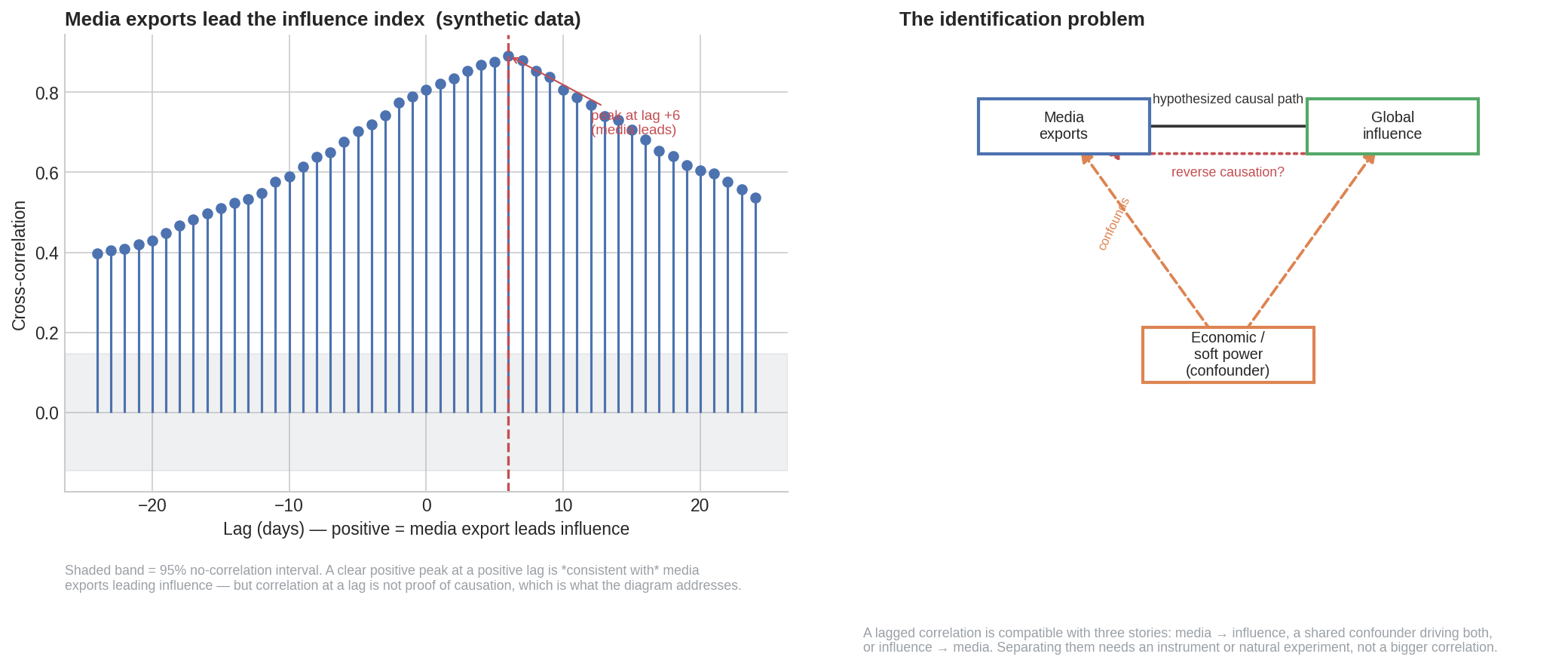
Synthetic data, real method: the cross-correlation shows a positive-lag peak consistent with media exports leading the influence index, but the DAG is the important guardrail. A lagged correlation is compatible with direct influence, a shared confounder, or reverse causation; it is not causal proof by itself.
10) What Rising Powers Can Learn
For rising powers today, the U.S. case suggests that influence requires more than GDP growth.
To build global cultural relevance, a country needs:
- globally legible stories
- exportable aesthetics
- trusted platforms
- language accessibility
- creator ecosystems
- distribution partnerships
- audience identification
- openness to remixing by foreign audiences
Media dominance cannot simply be ordered into existence.
It depends on whether global audiences want to participate in the culture.
That is why cultural power is difficult to manufacture.
It requires aspiration.
11) Research Limitations
This project must be careful about overclaiming.
Correlation does not prove causation.
Media success may reflect many hidden variables:
- language
- wealth
- production budgets
- political alliances
- migration patterns
- education systems
- technology access
- censorship regimes
- diaspora networks
The right framing is not:
American media caused American power.
The stronger framing is:
American media and American power formed a mutually reinforcing system, and this system can be compared with other historical and emerging powers.
12) Final Thought
The United States did not become globally relevant only because of Hollywood.
Hollywood did not become globally dominant only because of the United States.
The two grew together.
Power gave American media reach.
Media gave American power emotional texture.
One made the other visible.
That is the real insight.
Global dominance is not only about controlling territory, capital, or institutions.
It is also about controlling imagination.
References and further reading
- Joseph Nye, Soft Power: The Means to Success in World Politics: https://www.publicaffairsbooks.com/titles/joseph-s-nye-jr/soft-power/9781586483067/
- Harvard Kennedy School - Joseph Nye and Soft Power: https://www.hks.harvard.edu/faculty/joseph-nye
- USC Center on Public Diplomacy - Soft Power resources: https://uscpublicdiplomacy.org/
- UNESCO Institute for Statistics: https://uis.unesco.org/
- World Bank Open Data: https://data.worldbank.org/
- OECD Data: https://data.oecd.org/
- IMF Data: https://www.imf.org/en/Data
- Our World in Data: https://ourworldindata.org/
- UN Comtrade Database: https://comtradeplus.un.org/
- Motion Picture Association research: https://www.motionpictures.org/research-docs/
- IFPI Global Music Reports: https://www.ifpi.org/resources/
Related posts
- Reimagining the Attention Economy: Platform-Led Entertainment and Personalized Demand
- Personalized Ad Delivery Systems and the Future of Entertainment Distribution
- The Success Directory: A Decision Intelligence Framework for High-Stakes, Ambiguous Choices
- Tracking AI-Generated Content: Simple, Practical Systems for Text, Images, Code, and Execution Patterns
Relevant project links
- GitHub profile: https://github.com/ChinmayA301
- Portfolio / The Lab: https://app.chinmayarora.com
- Project repository: https://github.com/ChinmayA301/us-media-global-power-study
- Possible dataset direction: media exports, box office share, music chart presence, platform ownership, trade centrality, GDP share, military presence, international student flows
- Possible implementation stack: Python, Pandas, GeoPandas, NetworkX, World Bank API, OECD API, visualization dashboard
After the last line
Comments & sharing
Agree, disagree, add context, or send this to someone who would have a take.
Share
Public thread
Comments are public and attached to this post through GitHub Discussions. Sign in with GitHub to join the thread.
Open public discussions